A brief operation at production pace
Before powder coating, radiators, base plates, and heat-pump housings have to be suspended from a moving conveyor. The operation takes only a few moments, yet it combines several demanding motions: pick up, lift, align, and engage the exact suspension point.
With bulky workpieces, weight is only part of the strain. Repetition, a fixed cycle time, and holding parts at shoulder height place additional load on the back and upper body. At the same time, the part must not strike the line or hang incorrectly in its fixture.
ezzFLOW carries the load while the operator guides it
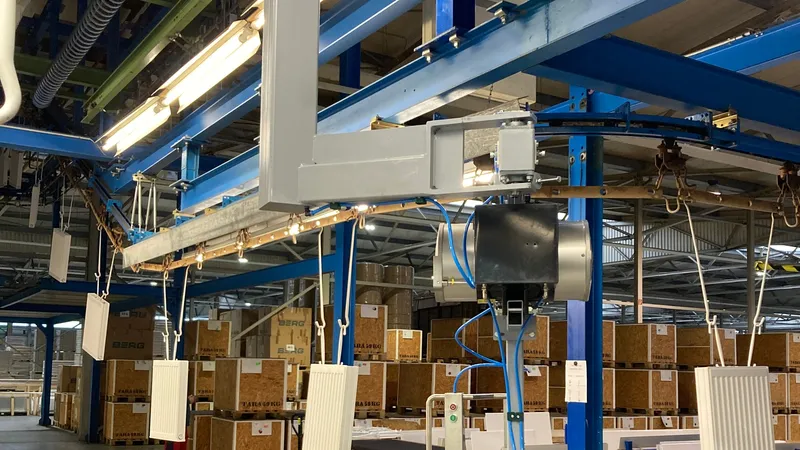
The ezzFLOW balancer provides force-assisted handling for this task. The system carries the part while the operator controls its motion directly. This makes it possible to guide the workpiece to the conveyor and align it before engagement.
A typical sequence has four steps:
- The load handling attachment grips the part at defined points.
- ezzFLOW raises the load to the required working height.
- The operator aligns the workpiece with the suspension point.
- The part is placed into the hook or carrier in a controlled motion.
The load remains guided throughout. Manual heaving and repeated regripping are avoided when the attachment and working envelope are designed correctly.
Load handling attachment based on part geometry
Radiators, sheet metal parts, and housings each require a different approach. Large surfaces may suit vacuum handling. Cutouts, edges, or defined holes may favor a mechanical gripper. In either case, the attachment must avoid damaging visible surfaces or interfering with the subsequent coating process.
The design review includes:
- Part weight and center of gravity
- Permitted contact and gripping surfaces
- Position of the suspension point
- Required turning or slewing motion
- Cycle time and repetition frequency
- Clear space along the motion path
The result is not a universal gripper. It is an attachment matched to the part and the process.
The working envelope must fit the conveyor
In addition to the balancer, the support structure determines which positions can be reached. An ezzLINK crane system can cover staging, pick-up, and the conveyor loading point. Columns, rails, and possible interference with the line are considered early in the layout.
The transfer to the conveyor deserves particular attention. The control handle must remain easy to reach, while the system must not interfere with the moving chain, neighboring carriers, or guarded areas.
A stable process before coating
A properly engineered handling system does more than reduce physical effort. It makes the transfer to the coating line more repeatable. Parts enter the conveyor in the intended orientation, corrective motions decrease, and the operator can focus on precise engagement.
For an initial design, BHT needs a part drawing, weights, the suspension point, cycle time, and a workstation layout. These inputs show which combination of balancer, support system, and gripper will support the process safely, productively, and ergonomically.