
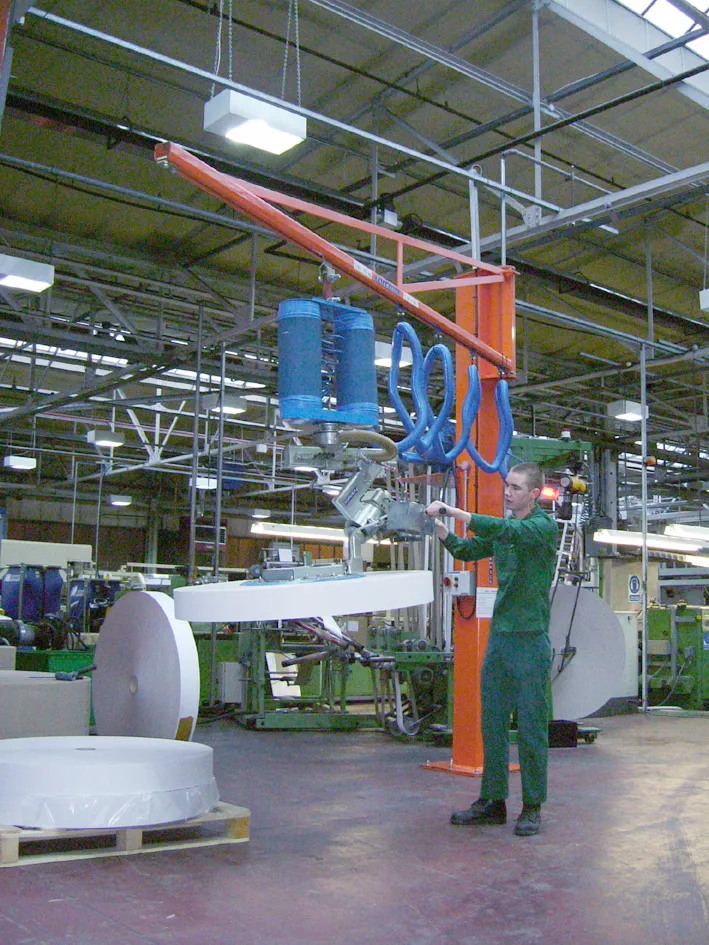
When the roll change sets the pace
In printing, labeling, and converting, the next paper or film roll must be ready before the current roll runs out. The task sounds simple. In practice, the team has to pick up heavy rolls and coils, turn them into the correct unwind direction, and align them precisely with a machine shaft.
Manual rolling, heaving, and readjustment extend changeover time. A second person is often required to stabilize the load during alignment. At the same time, edges, film layers, the winding, or the machine interface can be damaged.
A controlled changeover in five steps
A handling system connects staging and machine in one guided sequence:
- The roll is picked up from a pallet, rack, or staging point.
- The system raises it to a safe travel height.
- The roll is turned into the required unwind direction where necessary.
- Core and machine shaft are aligned.
- The roll is placed and released in a controlled motion.
The best way to perform these steps depends on the roll, core, and workstation. Two handling principles are particularly relevant.
Mobile lifting aid for core engagement and turning
The ezzLIFT lifting aid moves a roll directly from staging to the machine. A mandrel, fork, or purpose-built gripper provides positive engagement. Depending on the task, the attachment can also rotate the roll or reorient it between horizontal and vertical positions.
This approach suits plants where several machines must be supplied or where a fixed overhead crane is not practical. Travel path, floor, turning radius, and clear access to the machine shaft all form part of the layout.
Vacuum handling for suitable surfaces
The ezzFAST vacuum lifter can pick up rolls at a suitable end face or outer surface. This is particularly useful where short motion paths and fast lifting cycles are the main requirements.
Vacuum handling needs a sufficiently airtight and load-bearing contact area. Coating, film layer, protective wrapping, and available suction area are therefore tested with the actual material. Roll weight alone does not determine the suction cup.
Information required before design
The technical data define the gripper and motion principle:
| Criterion | Why it matters |
|---|---|
| Roll weight | defines capacity and safety margin |
| Outer and core diameter | determines mandrel or gripper geometry |
| Roll width | affects center of gravity and space requirements |
| Staging orientation | determines the required turning motion |
| Installation height | defines lifting travel and working envelope |
| Material surface | determines whether vacuum handling is possible |
| Space at the machine | limits chassis, gripper, and operator position |
Change frequency matters as well. A moderate roll weight can still create a high physical load when it is handled repeatedly throughout a shift.
Predictable changeover instead of improvisation
The right lifting technology guides the load through the complete roll change. Pick-up and transfer points become repeatable. The operator no longer has to hold the roll in an awkward posture and can focus on alignment.
For a project review, BHT needs roll dimensions, weights, photographs of staging and the machine interface, and the required motion sequence. This information shows whether a mobile lifting aid, a vacuum lifter, or another gripping principle is the best fit.