Every additional contact matters
Load weight is not the only concern in a cleanroom. Manual heaving often leads to regripping, bracing, or unplanned contact with the container and its surroundings. These additional motions make a clearly defined process harder to maintain.
A handling system carries the load and guides it along the intended motion path. The operator can work with fewer corrective grips. This requires the device, load handling attachment, and support system to match the specific cleanroom environment.
ezzFAST for repetitive pick-and-place
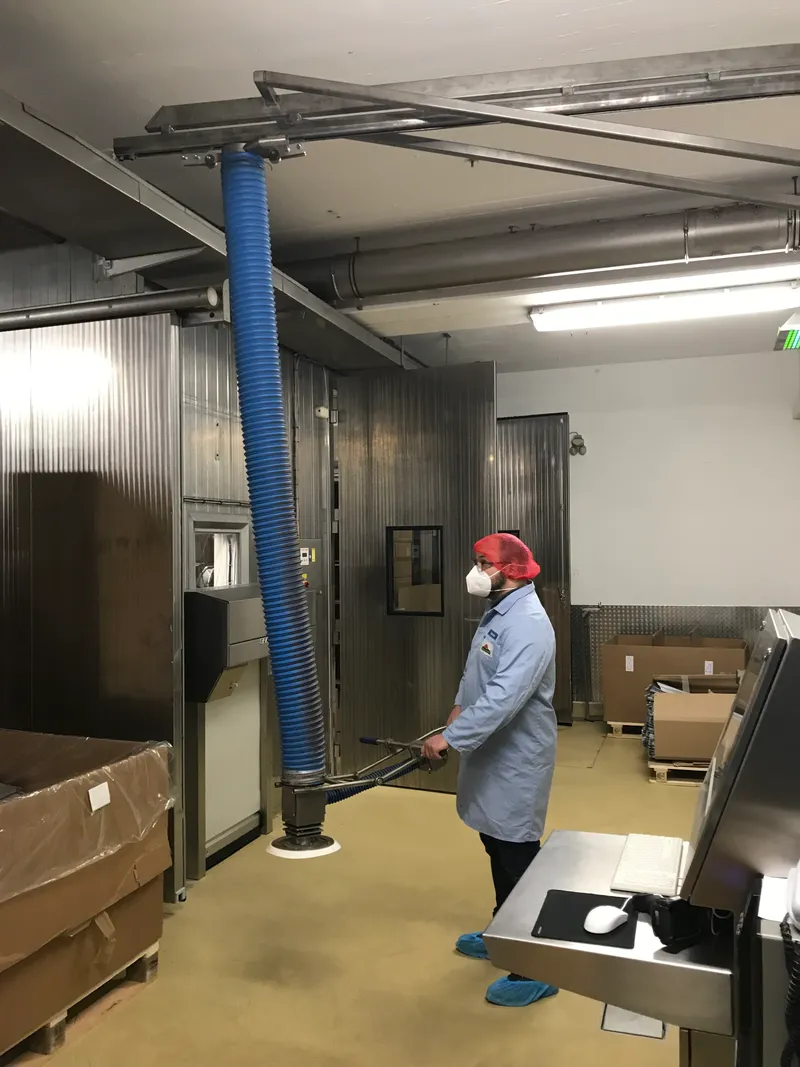
The ezzFAST vacuum lifter suits repetitive pick-and-place operations with compatible containers. The suction cup picks up the load at a defined surface. The operator guides it to its destination and sets it down in a controlled motion.
Typical tasks include:
- Moving cartons or closed containers at airlocks
- Transferring vessels between a pallet and process station
- Positioning raw material containers above equipment
- Making repeated transfers with fewer contact points
Container surface and airtightness must support vacuum handling. Film, liners, and porous materials are tested with the real packaging.
ezzFLOW for sensitive assemblies
The ezzFLOW balancer supports motions where controlled guidance and precise positioning matter more than high throughput. Examples include sensitive assemblies, process vessels, or workpieces that must enter a fixture in the correct orientation.
The balancer offsets the load weight. The operator controls direction and position. A purpose-built load handling attachment holds the component at defined points. This enables transfers with less manual heaving and fewer corrective motions.
Cleanroom suitability is a system property
A cleanroom solution is not created by one stainless steel component. All elements within the working area have to be considered together:
- Surfaces and materials
- Gaps, covers, and accessibility
- Lubricants and moving components
- Exhaust air and energy supply
- Cleaning and maintenance routines
- Load handling attachment and contact surfaces
The required configuration depends on cleanroom class, process, and the operator's cleaning concept. It cannot be inferred from a product name alone. A separate article explains how a mobile lifting aid can be configured for cleanrooms.
Which system fits which process?
| Task | Often suitable principle |
|---|---|
| fast transfer of compatible containers | ezzFAST vacuum lifter |
| precise positioning of assemblies | ezzFLOW balancer |
| mobile transport between workstations | ezzLIFT lifting aid |
| large working area across several stations | matched ezzLINK crane system |
This table is an initial guide, not a technical approval. Gripping surface, weight, motion path, and cleanroom requirements determine the final solution.
From process to system design
A sound review requires load data, photographs or drawings, pick-up and destination positions, and the applicable cleanroom requirements. BHT then considers gripping technology, working envelope, energy supply, and cleaning as one system.
The goal is a defined handling step with fewer manual contacts — engineered around the actual load and the requirements of your controlled environment.