
Packaging starts before the carton
A finished workpiece has to reach the packing station. It is then placed, transferred, checked for safe handling, and palletized. Load, gripping surface, and destination change at every station. Carton handling should therefore be planned as a process chain rather than a collection of isolated lifts.
The following five steps show typical transfers in packaging and intralogistics. They do not form a rigid standard process. Every line needs to be engineered around the workpiece, carton, cycle time, and workstation.
1. Guide the workpiece to packing
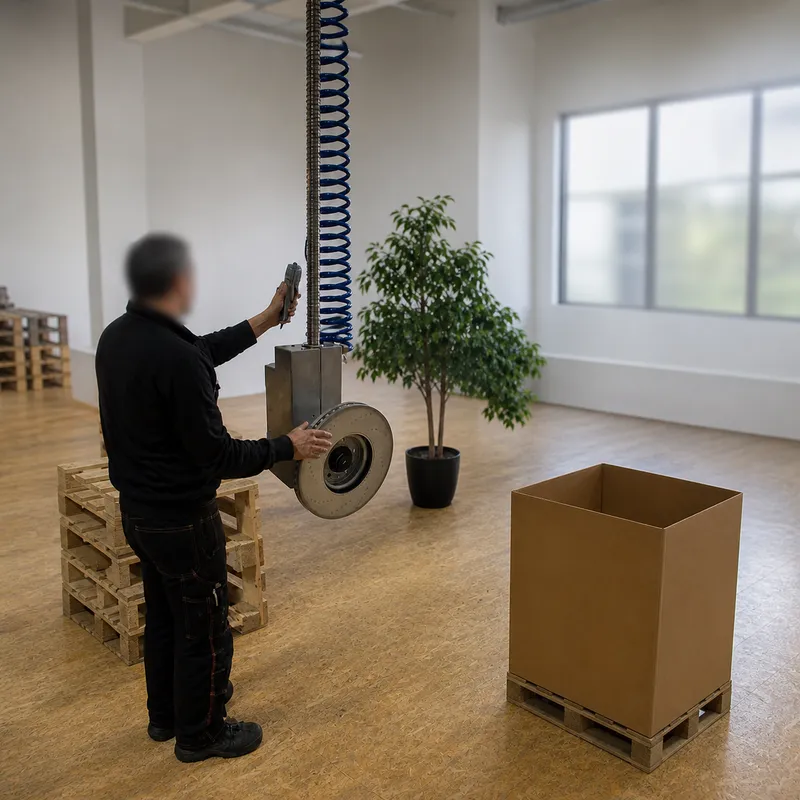
Round, sensitive, or unusually shaped workpieces often cannot be handled through the carton. The part itself must first be picked up. A purpose-built gripper holds it at defined points.
The ezzFLOW balancer carries the load while the operator aligns the workpiece and lowers it into a carton or crate. Less heaving and regripping protects both operator and part. It also creates a defined starting position for the next process step.
2. Place a carton inside an outer carton
When a smaller carton is placed inside an outer carton, the final vertical movement matters. Angled placement can crush the side walls or cause the carton to jam.
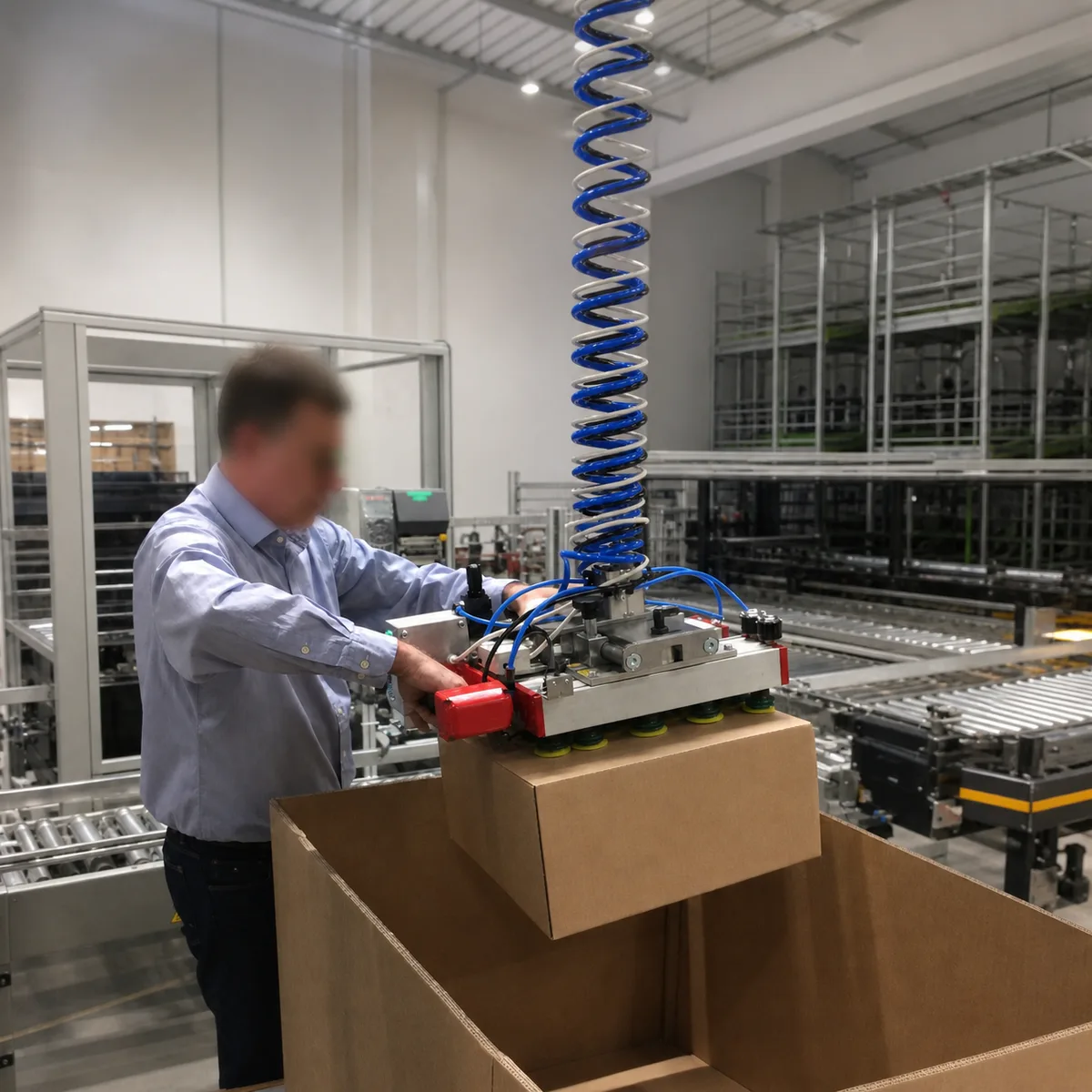
A vacuum gripper picks up the carton from above. The operator aligns it over the opening and lowers it in a controlled motion. Suction-cup arrangement, carton surface, and available clearance must work together.
3. Stabilize transfers at production pace
High throughput does not come from fast individual motions alone. Repeatable pick-up and set-down points are decisive. When gripping point and destination vary, time is lost to alignment and regripping.
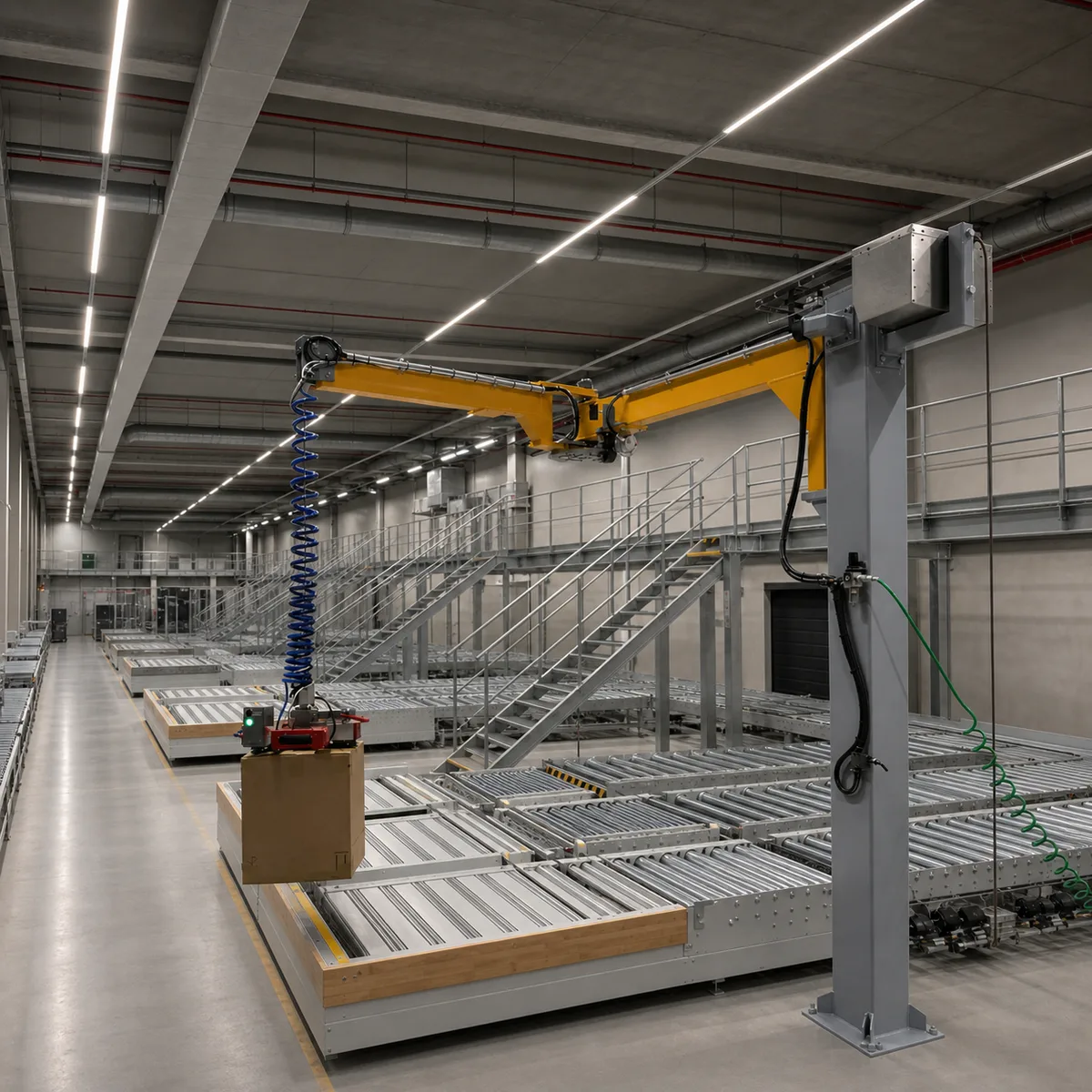
An integrated handling system guides the carton along a clear motion path. The ezzFAST vacuum lifter carries the weight. An ezzLINK crane system covers the working area between staging and conveyor equipment.
4. Test the actual vacuum pick-up
Vacuum handling requires the carton surface, effective suction area, cup arrangement, and center of gravity to be tested as one system. A shake test can show the holding margin of the actual combination under motion and impact.
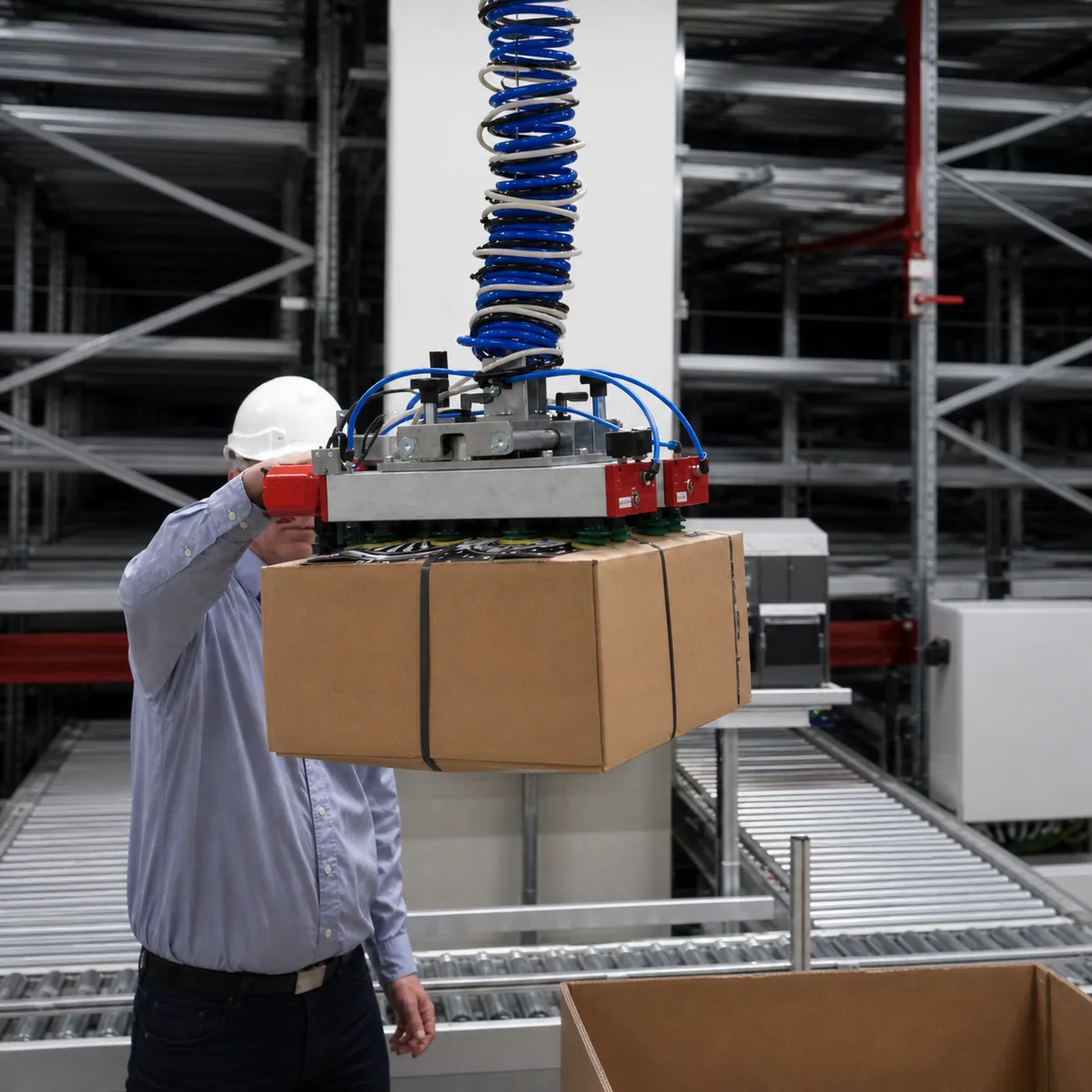
The response to loss of vacuum also forms part of the safety concept. In the configuration considered here, the load lowers in a controlled manner until it reaches a supporting surface. This behavior applies to the specific system configuration and is not a general claim for every vacuum solution.
5. Work ergonomically across the full pallet height
A carton does not have to be exceptionally heavy to create strain over a full shift. Repetition, reach, low pallet layers, and stack height act together.
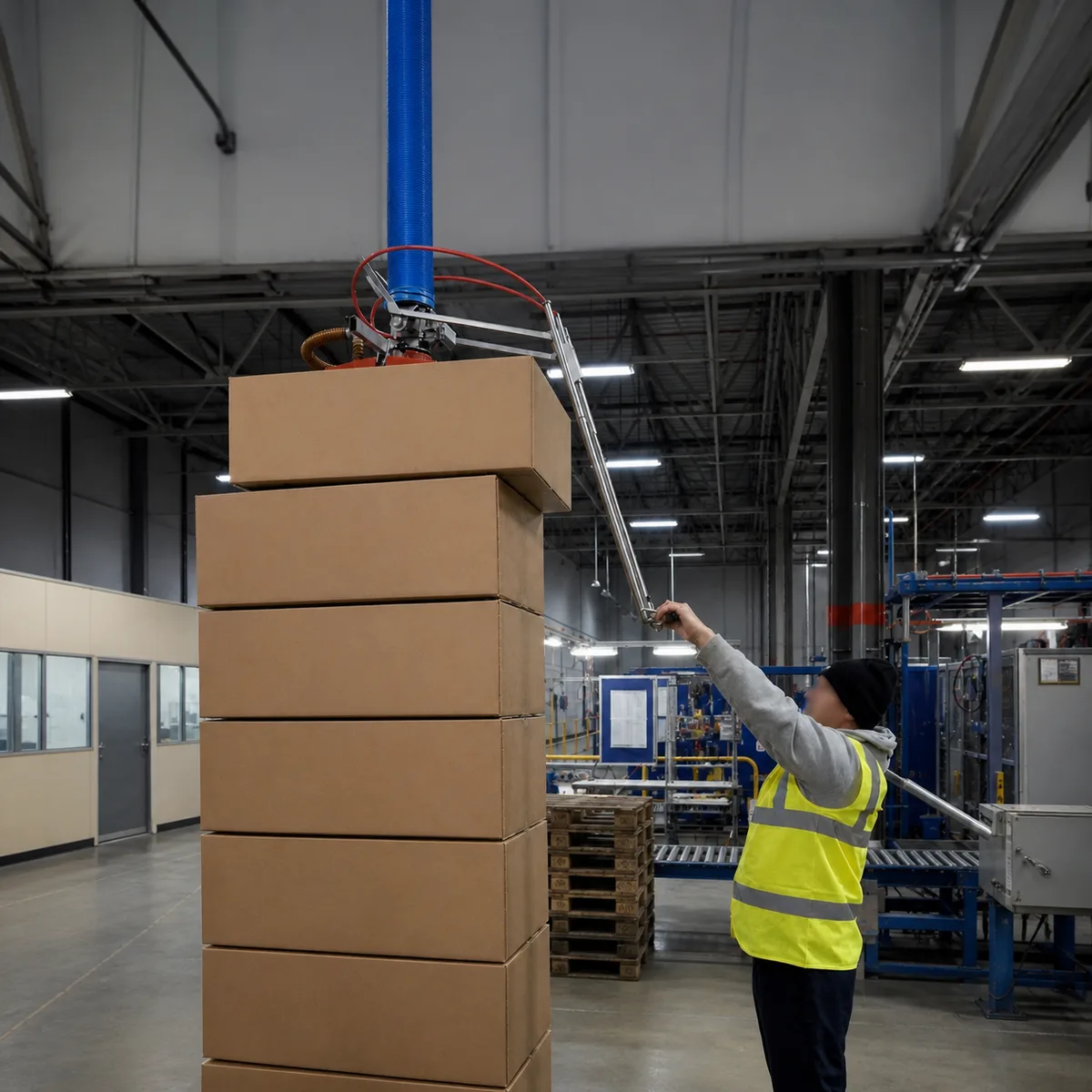
The vacuum lifter carries the weight while the operator guides the carton through the control handle. The design must cover the full workspace: lowest pick-up, highest set-down, horizontal reach, and possible obstructions.
Five steps, one planning process
| Process step | Central design question |
|---|---|
| Feed the workpiece | Where can the part be gripped safely? |
| Insert the carton | How does the target remain visible and accessible? |
| Stabilize the transfer | Where are the repeatable pick-up and set-down points? |
| Verify the vacuum | How do carton, suction cups, and system respond to motion? |
| Palletize | What working envelope is required across the full shift? |
Planning these stations together prevents a local improvement from creating a new issue at the next transfer. BHT engineers gripper, lifting device, and support system around the complete packaging workflow — for safety, productivity, and ergonomics across the process chain.